Engineered enzymes open new routes to building complex molecules
An international team of researchers have engineered enzymes that form diverse carbon鈥揷arbon and carbon鈥搉itrogen bonds, broadening the reactions possible with biocatalysts and enabling precise control of molecular structures.
Researchers from the 野狼社区 Institute of Biotechnology, including and , have developed a new family of engineered enzymes that can create several different types of chemical bonds used to build complex molecules. This work demonstrates how artificial enzymes can be adapted to carry out a broad range of carbon-carbon (C-C) and carbon-nitrogen (C-N) bond-forming reactions with high levels of selectivity, offering new possibilities for biocatalysis.
, the research addresses a long-standing challenge in chemistry: developing biological catalysts that can selectively construct complex molecular architectures. Carbon-carbon and carbon-nitrogen bonds are fundamental building blocks in many chemicals, pharmaceuticals and advanced materials.

Biocatalysis has transformed our ability to carry out many chemical reactions using enzymes, but there are still important areas of chemistry that remain difficult to access. In this work, we show that artificial enzymes can be engineered to perform a wide variety of bond-forming reactions. What is particularly exciting is that the same underlying catalytic strategy can be adapted to work with many different reaction partners. This versatility gives us a foundation for developing new enzyme platforms capable of producing a wide range of valuable chemical structures.
To expand upon the reaction pathways found in natural enzymes, the researchers engineered proteins containing a non-natural catalytic amino acid. This facilitated the development of a new enzyme class, termed allylic transferases, which form highly reactive imidazolium intermediates that could then be intercepted by a variety of carbon- and nitrogen-containing molecules, selectively producing a diverse range of products.
The team used directed evolution to improve enzyme performance. One evolved variant, known as ASB1.3, achieved more than 99% conversion in several reactions while delivering products with high stereochemical purity. In a preparative-scale reaction, the enzyme produced the target compound with 98% conversion.
A second enzyme variant, ASA1.5, enabled the formation of molecules containing all-carbon quaternary stereocentres, structures that can be challenging to synthesise selectively. In preparative-scale experiments, the enzyme achieved 98% conversion.
The researchers demonstrated that the engineered enzymes could work with a broad range of reaction partners, including substituted furans, indoles, pyrroles, cyanoesters, diketones, ketoesters, anilines and isatins. Across the reactions examined, the enzymes generated a single major product with no observable by-products other than the released leaving group used for monitoring the reaction.
Expanding the biocatalysis toolbox
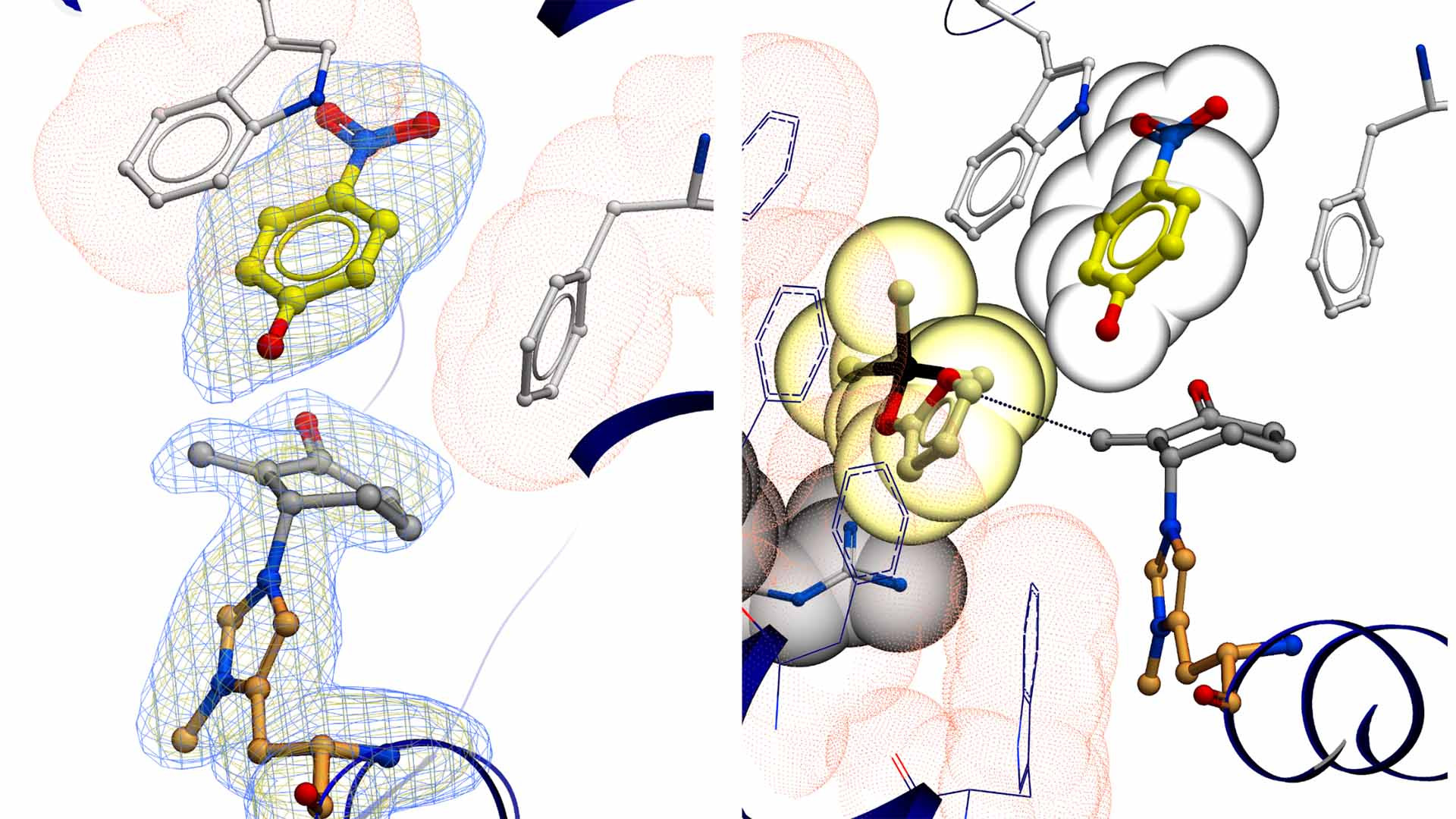
Structural analysis also provided new insights into how the enzymes achieve their selectivity. The team found evidence that a para-nitrophenol group released during the reaction remains in the enzyme active site and helps orient incoming reactants, contributing to stereoselective bond formation.
While further development will be needed before these enzymes can be applied more widely, the study expands the range of chemical transformations available through biocatalysis. The study highlights how engineered protein catalysts can provide new ways to access molecular structures that are difficult to produce using established small-molecule catalysts.
First author Zachary Birch-Price said:
By combining enzyme engineering with non-natural catalytic chemistry, we were able to create a family of bond-forming enzymes new to the biocatalytic repertoire. We hope these findings will help guide the development of future enzyme platforms for selective chemical synthesis.
This research was published in: Nature Catalysis
Full title of the paper: Protein-confined imidazolium intermediates enable diverse biocatalytic C鈥揅 and C鈥揘 bond formations
DOI: 10.1038/s41929-026-01587-8
URL: