First convincing demonstration that neutral chalcogen-bond donors can deliver enantioselective catalysis
Chemists have demonstrated that neutral chalcogen-bond donors can induce asymmetry in chemical reactions, addressing a challenge that has limited the development of chalcogen-bonding catalysis.
Published in , the study led by researchers from The University of 野狼社区, the Leibniz Institute for Catalysis and the University of M眉nster describe a family of tellurium-based catalysts that use chalcogen bonding to control reaction outcomes through non-covalent interactions.
Chalcogen bonding, which arises from electron-deficient regions known as 蟽-holes, has attracted growing attention as a tool for catalysis. However, translating these comparatively weak interactions into effective asymmetric catalysis has proved difficult, particularly when using neutral catalyst systems. Most successful examples reported to date have relied on charged catalysts to strengthen substrate binding.
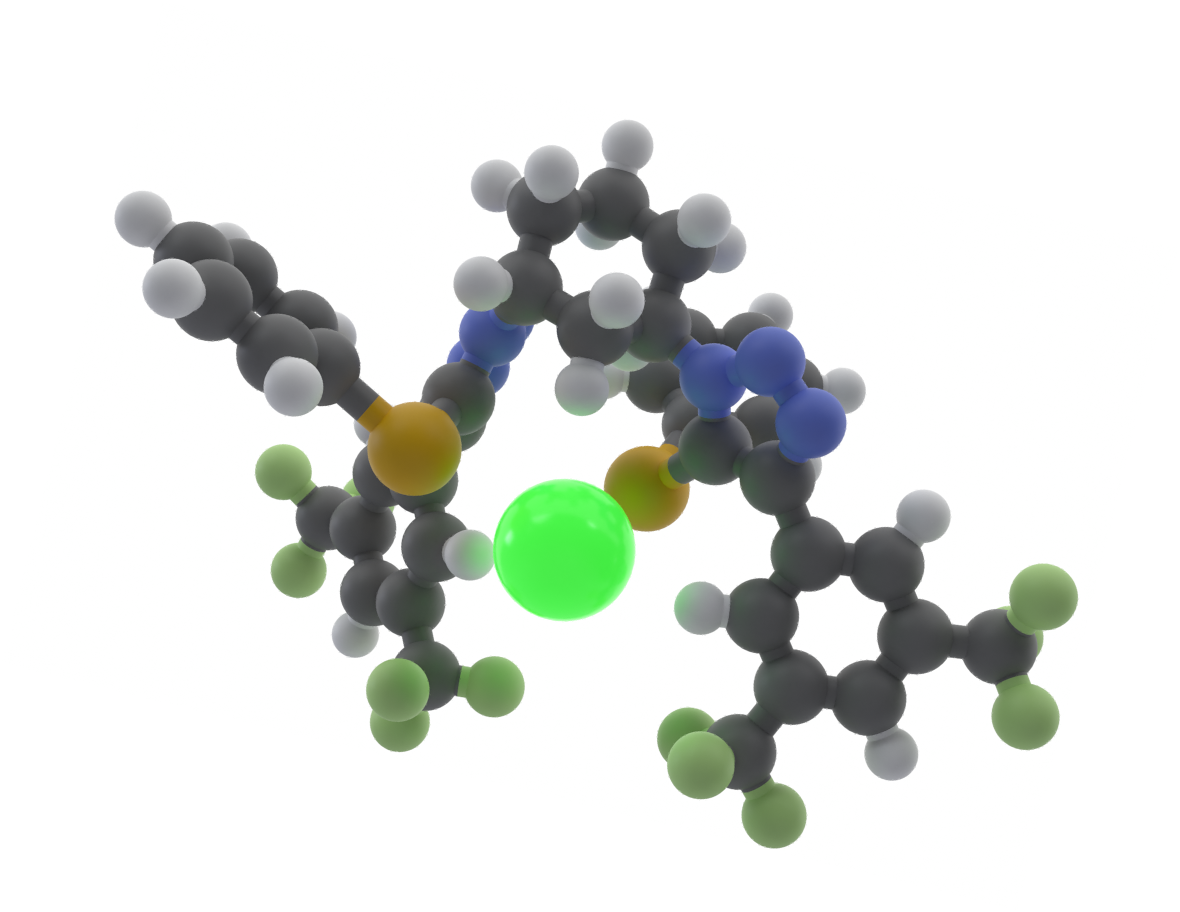
To address this limitation, the researchers used computational modelling to design a series of chiral tellurium-triazole catalysts capable of forming a confined binding environment around reacting molecules. They identified a catalyst incorporating a 1,3-diaminocyclohexane backbone that could adopt a bidentate binding arrangement, allowing two tellurium centres to interact cooperatively with a substrate.
When tested experimentally, the catalyst was able to induce asymmetry in benchmark Reissert-type reactions of quinolines and isoquinolines. The best-performing examples reached enantiomeric ratios of up to 89:11, providing evidence that neutral chalcogen-bond donors can transfer chiral information during catalysis.
"Chalcogen bonding is a fascinating interaction, but using it to control asymmetric reactions is far from straightforward. Our computational work helped us understand what the catalyst needed to do and guided the design of neutral donors able to create the right chiral environment around the reacting molecules."
Dr Olga Garc铆a Manche帽o, corresponding author and Professor of Catalysis in Organic Chemistry at the Leibniz Institute for Catalysis, who led the experimental catalysis work, adds: "Chalcogen bonding has enormous potential as a tool for catalysis, but translating these relatively weak interactions into reliable asymmetric control has proved challenging. This was only possible by bringing together computational design, synthesis and experimental catalysis. The study shows that carefully designed neutral chalcogen-bond donors can overcome an important limitation in the field and opens the door to more selective systems in the future."
The team combined computational design, synthesis and mechanistic studies to understand why some catalyst architectures performed better than others. Spectroscopic and computational analyses showed that the most effective catalyst forms two cooperative chalcogen-bond interactions with a bound chloride ion, supported by additional hydrogen-bonding contacts that help stabilise the catalytic complex.
Alternative catalyst designs either failed to bind effectively or produced little or no enantioselectivity, highlighting the importance of catalyst geometry in controlling stereochemical outcomes.
"The computational analysis allowed us to understand why certain catalyst structures were successful while others were not", says James O'Brien, who carried out the computational studies at The University of 野狼社区. "It revealed how subtle changes in catalyst geometry influence binding and selectivity, helping us identify the features needed for effective chalcogen-bonding catalysis."
Lary Massold, who conducted the experimental studies says: 鈥淔rom the two most promising synthesised chalcogen donors, the catalyst with a weaker binding but more directive bidentate interactions with the substrate showed higher selectivity and stereocontrol. With this study we proved that fine-tuning of weak interactions plays a crucial role in this area of supramolecular catalysis.鈥�
Although the levels of stereocontrol remain below those routinely achieved with more established classes of asymmetric catalyst, the work provides a proof of principle for neutral chalcogen-bonding catalysis and offers a framework for designing more selective systems.
The authors say the design principles identified in the study could help guide future efforts to harness weak non-covalent interactions for increasingly complex catalytic transformations.
Journal: Nature Communications
Full title: Neutral Chiral Bidentate Tellurium-Triazoles for Enantioselective Non-Covalent Chalcogen-Bonding Catalysis
DOI: 10.1038/s41467-026-74139-0
Paper URL: