Inflammation-related protein changes could help predict cognitive impairment after a stroke- especially in smokers
Researchers at The University of 野狼社区 have found that tracking changes in a protein linked to inflammation (interleukin-6) after a stroke could help identify people at risk of later memory and thinking problems (also known as cognitive problems). The study also suggests that smoking may make people more at risk of memory and thinking problems in association with ongoing inflammation after a stroke.
The research, published in is part of the Stroke IMPaCT study (Stroke 鈥� Immune Mediated Pathways and Cognitive Trajectory), a network of European and North American researchers who are working to discover how inflammation and immune responses contribute to post-stroke cognitive decline.
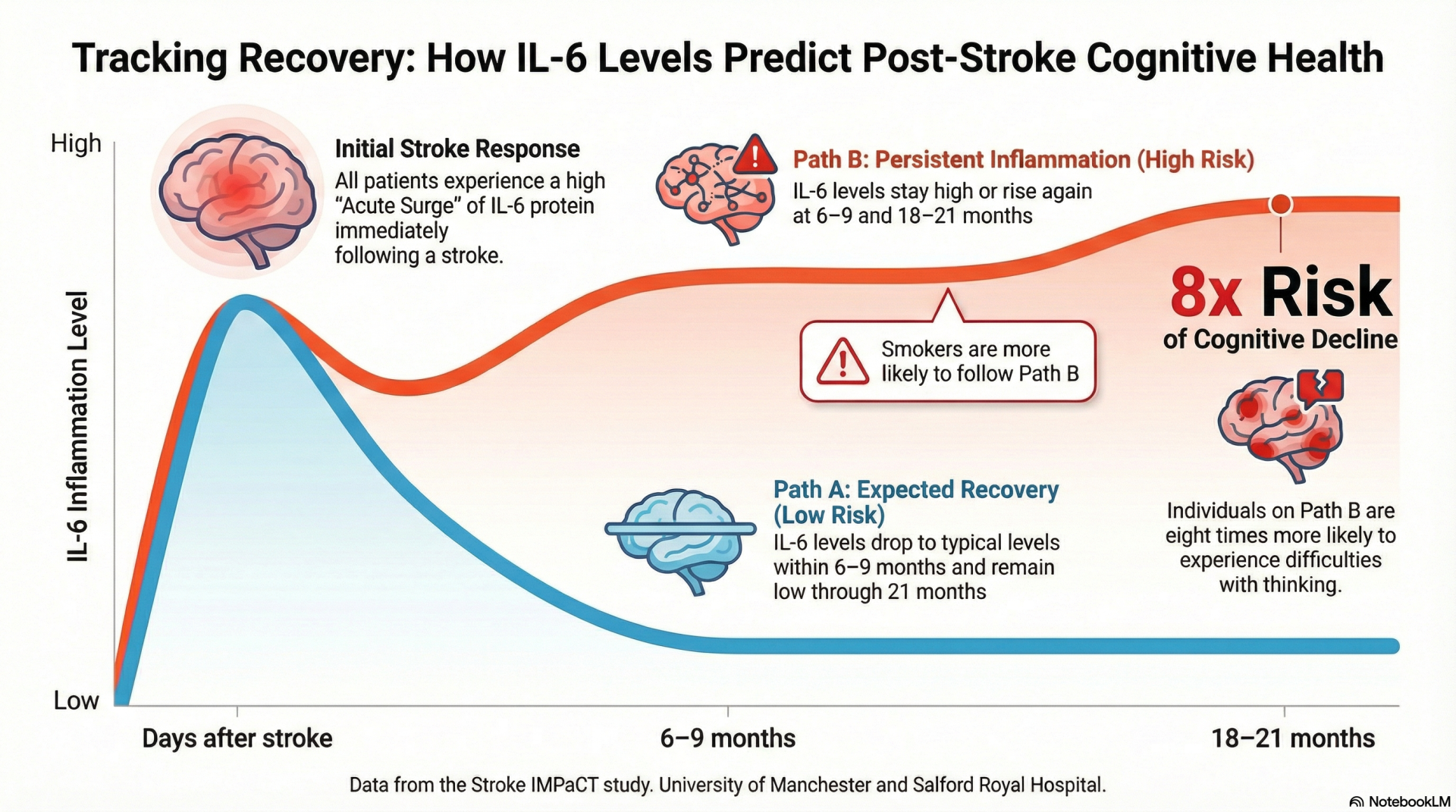
The team followed patients treated for an ischaemic stroke at Salford Royal Hospital, part of Northern Care Alliance NHS Foundation Trust. They measured levels of a protein called interleukin-6 (IL-6) in the days after stroke and again at both 6-9 and 18-21months. Participants also completed detailed tests of memory and thinking.
Interleukin-6 levels increased soon after stroke and, in most people, fell back to typical levels within 6-9 months. But in some patients, levels stayed high or rose again. These individuals were about eight times more likely to develop difficulties with thinking ability.
The researchers also saw differences between smokers and non-smokers. Smokers showed a different pattern of IL-6 change after stroke, with signs of longer-lasting inflammation. This ongoing inflammation was more strongly linked to problems with thinking and memory.
Lead author an MBPhD researcher at The University of 野狼社区, said: 鈥淚nflammation after stroke doesn't just happen once and disappear. By tracking this protein over time, we may be able to identify patients at greater risk of cognitive problems and eventually tailor support or treatments to them.鈥�
Inflammation after stroke doesn't just happen once and disappear. By tracking this protein over time, we may be able to identify patients at greater risk of cognitive problems and eventually tailor support or treatments to them
Professor Craig Smith, Professor of Stroke Medicine at The University of 野狼社区 and Consultant at Salford Royal, said: 鈥淥ur findings suggest it's not just the initial spike in inflammation that matters- it's whether it properly settles down after the stroke. Smoking appears to interfere with this recovery, leaving people more vulnerable to memory and thinking problems.
Professor Stuart Allan added: 鈥�When the immune system's recovery after stroke doesn't occur as expected, patients appear more likely to experience cognitive difficulties. If future studies confirm interleukin-6 is the cause, we might one day use medications that block it to protect brain health.鈥�
Co-lead author Harry Deijnen from the University of 野狼社区 added: 鈥淭hough it is clear that more research is needed, these results point towards new opportunities to improve long-term brain health by focusing on the body鈥檚 inflammatory recovery after stroke.鈥�
- The work was funded by the Leducq Foundation, Kennedy Trust, the National Institute for Health and Care Research (NIHR), and the British Heart Foundation. Philanthropic support has also been central to enabling this research. The University is proud to partner with donors in support of this work, including Louis and Amy Wong. Find out more about how supporting 野狼社区 drives impact across our research here: Challenge Accepted. It was supported by the National Institute for Health and Care Research (NIHR) 野狼社区 Biomedical Research Centre (BRC)鈥�
- The paper Longitudinal Plasma IL-6 and Post-Stroke Cognitive Outcomes: The Stroke-IMPaCT Study is available DOI: