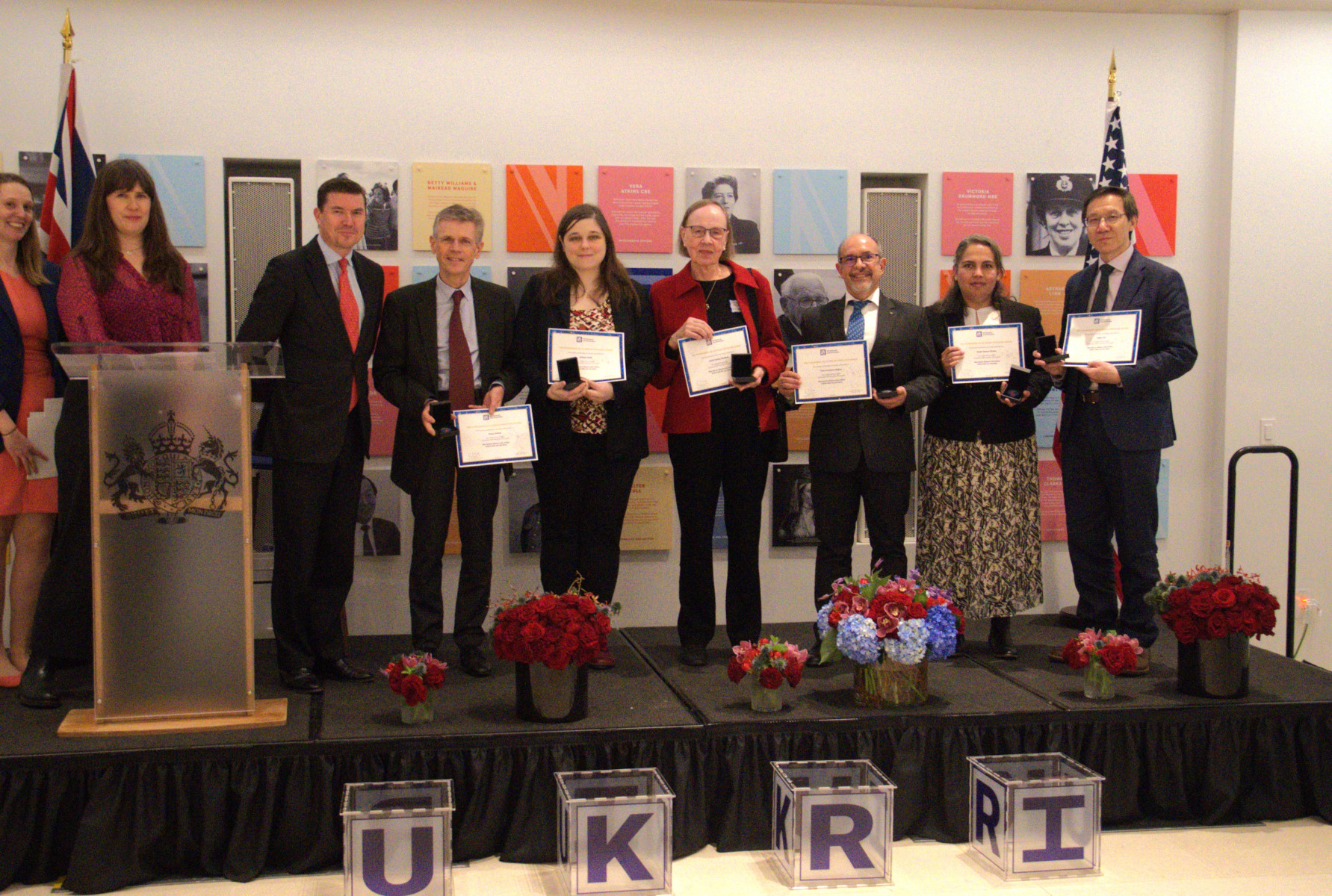
Two 野狼社区 researchers honoured for outstanding global impact through international collaboration
Two 野狼社区 researchers, Professor Bruce Grieve and Professor Hujun Yin, were recognised with the Pioneering UK-US Breakthroughs (PUB) award, by the UK Research and Innovation in the British Embassy in Washington, D.C this week.
Professors Grieve and Yin were honoured for their research in developing a new device to detect crop viruses, alongside peers from Rothamsted Research in the UK, and Rutgers and North Carolina State University in the US.
The new tool can detect early-stage viral infections in crops more rapidly and in a less expensive way than traditional methods of genetic testing, with the project addressing Cassava Mosaic and Brown Streak diseases in particular, which threaten a key carbohydrate crop found in Sub-Saharan Africa and Latin America: Cassava.
As Cassava is increasingly used as a replacement for wheat flour in the US and Europe, the new technology can increase our ability to safeguard our food security, by identifying and containing diseases before they spread and devastate crops.
Vice-President for Research, Colette Fagan, commented, 鈥�I was delighted to attend this UKRI award event at the British Embassy, Washington, as part of a Russell Group delegation visit to meet with USA universities and research funders. Professors Grieve and Yin's team was one of the small number of teams to be awarded this new prize, and I was proud to see their work at our University recognised and celebrated by the Washington audience.鈥�
The PUB awards are centred around research collaboration between the UK and US, and celebrate the impact of bringing together researchers and scientists on both sides of the Atlantic to address global challenges through innovation partnerships.
It was a great honour and encouragement for our work, and shows the importance of transatlantic collaborations, as well as the positive impact that AI and advanced sensing can make in tackling the challenges facing the world in terms of food, energy and sustainability.
In the case of this revolutionary new tool, it was The University of 野狼社区 and the Rothamsted Research facility鈥檚 sensor engineering and machine learning expertise who provided the UK鈥檚 share of research impact, which combined with the US institutions鈥� crop virology capabilities, to bring about this step towards a more secure global food supply.
Prof Grieve commented, 鈥淩eceiving the US-UK reward brought home to me the impact that working with complimentary teams across the globe, and across engineering and the life-sciences, can have 鈥� with the crop viruses that we are working on threatening the main carbohydrate source for 800 million people in Africa and Latin-America.鈥�
Not only have our researchers contributed to creating a more resilient future for worldwide food system - but their device will also be supporting local livelihoods and strengthening rural economies, where the effects of crop loss are felt most keenly in developing areas of the world.
Dr Grieve and Prof Yin were handed their awards by HM Ambassador to the US, Sir Christian Turner, and UKRI鈥檚 International Director, Frances Wood, and were one of seven collaborations recognised, from cancer research to particle physics.
Prof Yin, said of the occasion, 鈥淚t was a great honour and encouragement for our work, and shows the importance of transatlantic collaborations, as well as the positive impact that AI and advanced sensing can make in tackling the challenges facing the world in terms of food, energy and sustainability. While in this project we target cassava brown steak virus, the device, once verified in field tests in Tanzania over next few months, could be extended to other produces.鈥�
This work was funded by the Biotechnology and Biological Sciences Research Council and US National Science Foundation through the Ecology and Evolution of Infectious Disease Programme.