Artist Provenance expert and CTO of Massive Attack visits University for collaborative activities exploring AI, copyright and creative authorship
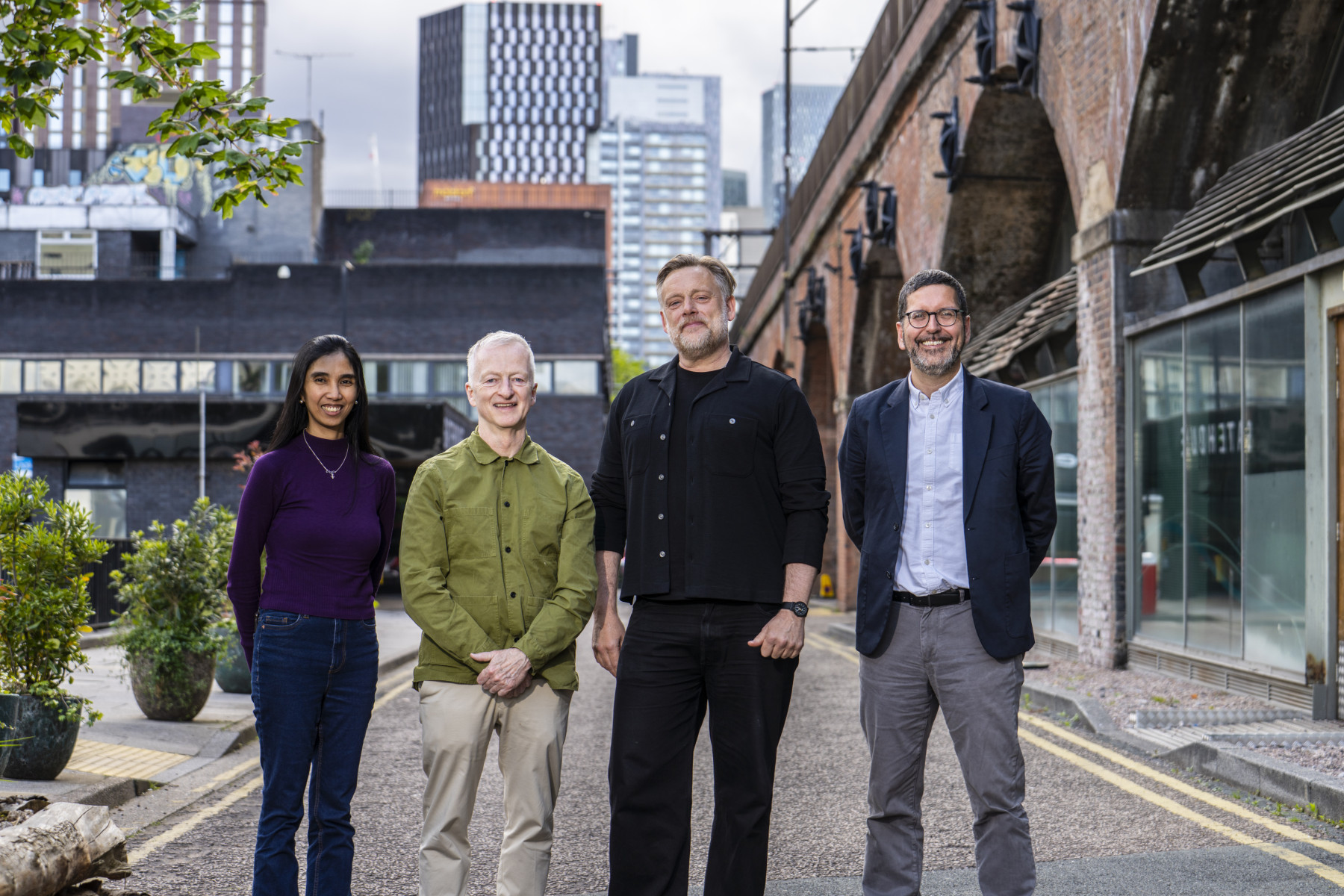
Creative Ò°ÀÇÉçÇø were delighted to welcome internationally renowned composer, producer and creative technologist to The University of Ò°ÀÇÉçÇø’s School of Arts, Languages and Cultures for a two-day programme of activities from 18–19 May 2026. The visit brought together students, academics, policymakers, and the public to explore questions with the founder of artist provenance organisation around the future of creative authorship, copyright and musicmaking in the age of artificial intelligence.
Occurring at a pivotal moment in the debates around AI and intellectual property, the visit also highlights a number of timely developments in the artist provenance sphere. These include the appointment of Sir Robin Jacob, former Lord Justice of Appeal in Intellectual Property, to the Genotone Ltd. advisory board, a significant endorsement of artist provenance infrastructure.
is a British-German creative technologist with over 25 years at the intersection of music, technology, and art. As CTO of and founder of , he has spent his career building the infrastructure that connects creative practice to emerging technology, from pioneering work on one of the world's first artist websites with David Bowie in 1999 to encoding Massive Attack's Mezzanine into synthetic DNA with ETH Zürich.
Andrew advises the UK government's Department for Culture, Media and Sport and Department for Science, Innovation and Technology’s Working Groups on AI and copyright, representing coalitions of over 30,000 artists through the Music Managers Forum, Featured Artists Coalition, and AFEM. He is a leading voice on artist provenance, AI transparency, and the future of creative rights in the age of generative AI.
At the heart of the visit was the major public lecture Proof of Human: AI, Copyright, and the Fight for Creative Authorship, which took place at the heart of the Innovation District at SISTER.
In this special lecture and discussion, Andrew Melchior presented a compelling case for strengthening creative authorship in the era of generative AI.
Drawing on his experience advising UK government technical working groups on AI and copyright, Melchior explored how large-scale AI systems trained on vast datasets of copyrighted material, often without consent or compensation are disrupting established frameworks for protecting creative work. He argued that the challenge facing artists today is not only legal but infrastructural: without reliable systems to verify authorship and trace creative lineage, existing rights regimes cannot be effectively enforced.
Following the lecture, he was joined in conversation by John McGrath, Artistic Director and Chief Executive of Factory International, and responded to audience questions.
Earlier in the day, Melchior lead an interactive masterclass for undergraduate and postgraduate music and composition students.
The session focussed on practical workflows for producing and releasing music while maintaining provenance and control of intellectual property in a rapidly evolving AI landscape. Students engaged directly with Melchior and explored the real-world implications of emerging technologies on their creative practice.
The visit also included a roundtable discussion bringing together academic experts and policymakers. They examined the relationship between music, culture, technology, and Ò°ÀÇÉçÇø’s creative heritage; the impact of AI and other technologies on the creative industries and mechanisms to protect the rights and livelihoods of creative practitioners.
This visit was part of Creative Ò°ÀÇÉçÇø’s ongoing commitment to fostering interdisciplinary collaboration and critical debate at the intersection of culture, technology, and society.
The University of Ò°ÀÇÉçÇø is one of the few places in the UK where the technical and cultural dimensions of this debate genuinely intersect. I will be talking about what it means, in practice, to prove that something was made by a human being, why that question has become the central legal and ethical challenge in music, and how the infrastructure we are building at Genotone intends to answer it at scale, for every artist. We represent around 30,000 artists through MMF, FAC and AFEM in the government technical working groups on AI and copyright. This is not a theoretical conversation.