Ever wondered how computers predict what water will do? The way we model it matters.
How accurately can we predict what water will do when a river floods, a wave hits an offshore structure, or currents sweep around a tidal turbine?
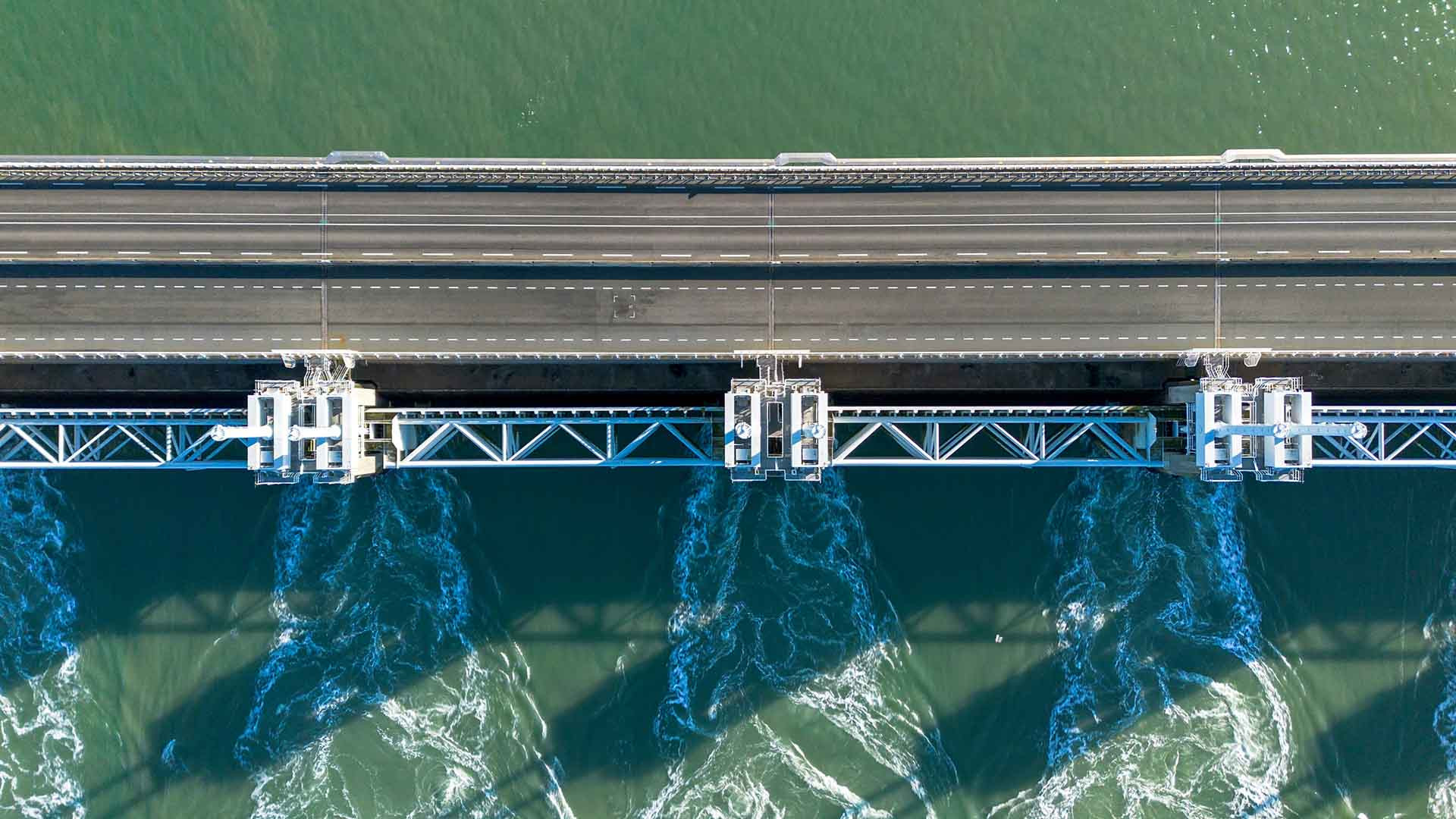
Water can break, mix, swirl and change direction in ways that are difficult to reproduce accurately on a computer. Yet engineers and researchers increasingly rely on computer simulations to understand these flows and design safer, more efficient systems.
I argue that if we want computer simulations to predict these difficult flows reliably, we need turbulence models that are suited to the way the water is represented in the simulation.
Turbulence is one of the biggest challenges in predicting fluid motion. Its irregular and constantly changing motion affects how water mixes, transports energy and interacts with its surroundings. Because resolving every turbulent motion directly would require enormous computational resources, researchers use turbulence models to represent some of these effects.
But I believe we should question a common assumption: that a turbulence model appropriate for one type of simulation will automatically be appropriate when the flow is represented using a different approach.
In grid-based computer simulations, the flow is represented by dividing the computational domain into many small cells, forming what is known as a computational grid. Imagine dividing a swimming pool into millions of tiny boxes and calculating what happens inside each one. Over many years, a wide range of turbulence models has been developed for these grid-based simulations.
There is another way to represent a flow: particle-based simulations. Instead of describing the flow using a grid, particle-based simulations represent the fluid using many particles that move, interact and carry information about the flow around them.
This approach has an important advantage. In flows where the shape of the fluid or the region occupied by the water changes significantly, managing a grid can become difficult. Particles can move naturally with the flow, allowing particle-based simulations to handle these changes without requiring the same grid adjustments.
But this method needs a turbulence model that is designed to account for its own characteristics, rather than simply using a model transferred from grid-based simulations. A model being well established for grid-based simulations does not necessarily mean that it is compatible with particle-based simulations. Using an established model may be convenient, but convenience should not be confused with compatibility.
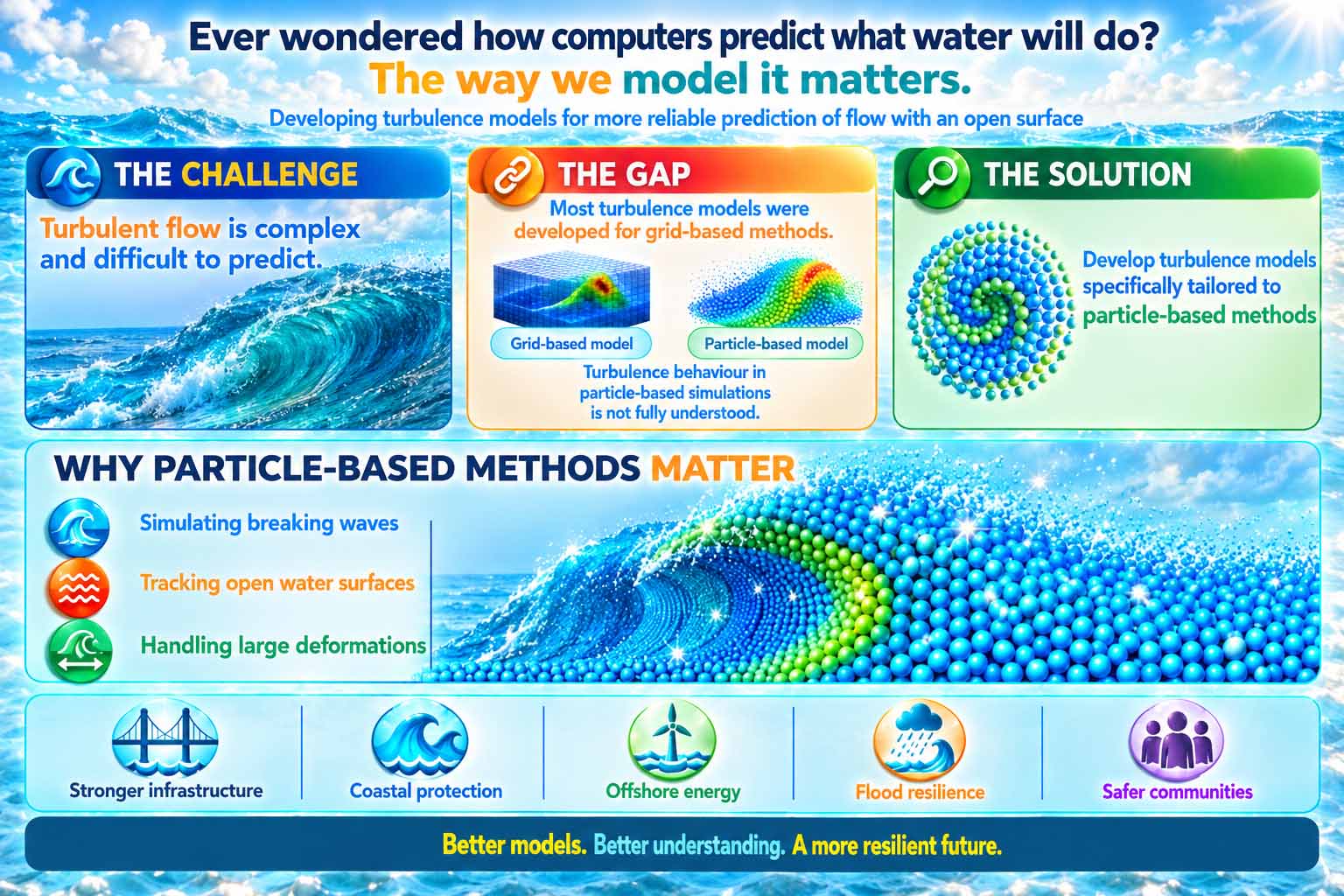
The need for compatibility becomes even more important in complex flows. Turbulence behaves differently near solid boundaries than farther away, while flows with changing water surfaces introduce additional interactions and numerical challenges. A model that performs well in an idealised test may therefore not be equally reliable in the engineering and environmental situations for which these simulations are ultimately used.
These challenges are at the centre of my PhD research at The University of 野狼社区. Rather than simply applying an existing turbulence model to a particle-based simulation, I am investigating how turbulence modelling can be developed and evaluated specifically for particle-based simulations. My first year has focused on building the foundations through studying turbulence, particle-based simulations, existing research and numerical formulations, before moving towards the development of a new modelling approach.
The importance of these considerations becomes clearer when turbulence models are used for real-world decisions. As extreme flooding becomes an increasingly important engineering concern and investment grows in resilient infrastructure and offshore renewable energy, computational predictions can influence decisions with significant economic and societal consequences. For example, in an urban flood simulation, predictions of flow depth and velocity around buildings can influence the design of flood defences and evacuation planning, while uncertainties in turbulence modelling may affect these predicted flow characteristics. The more we rely on simulations, the more carefully we need to understand what lies behind their predictions.
This may sound like a specialised numerical problem, but it reflects a broader principle in computational science: models should be judged not only by the results they produce, but also by whether their assumptions are compatible with how the underlying system is represented.
My research therefore starts from a simple proposition: better modelling is not about more complexity; it is about the right model for the right method.

Meet the researcher
Jafar Gerdabi is a PhD researcher at The University of 野狼社区 working on turbulence modelling within the Smoothed Particle Hydrodynamics (SPH) method for free-surface flows.